
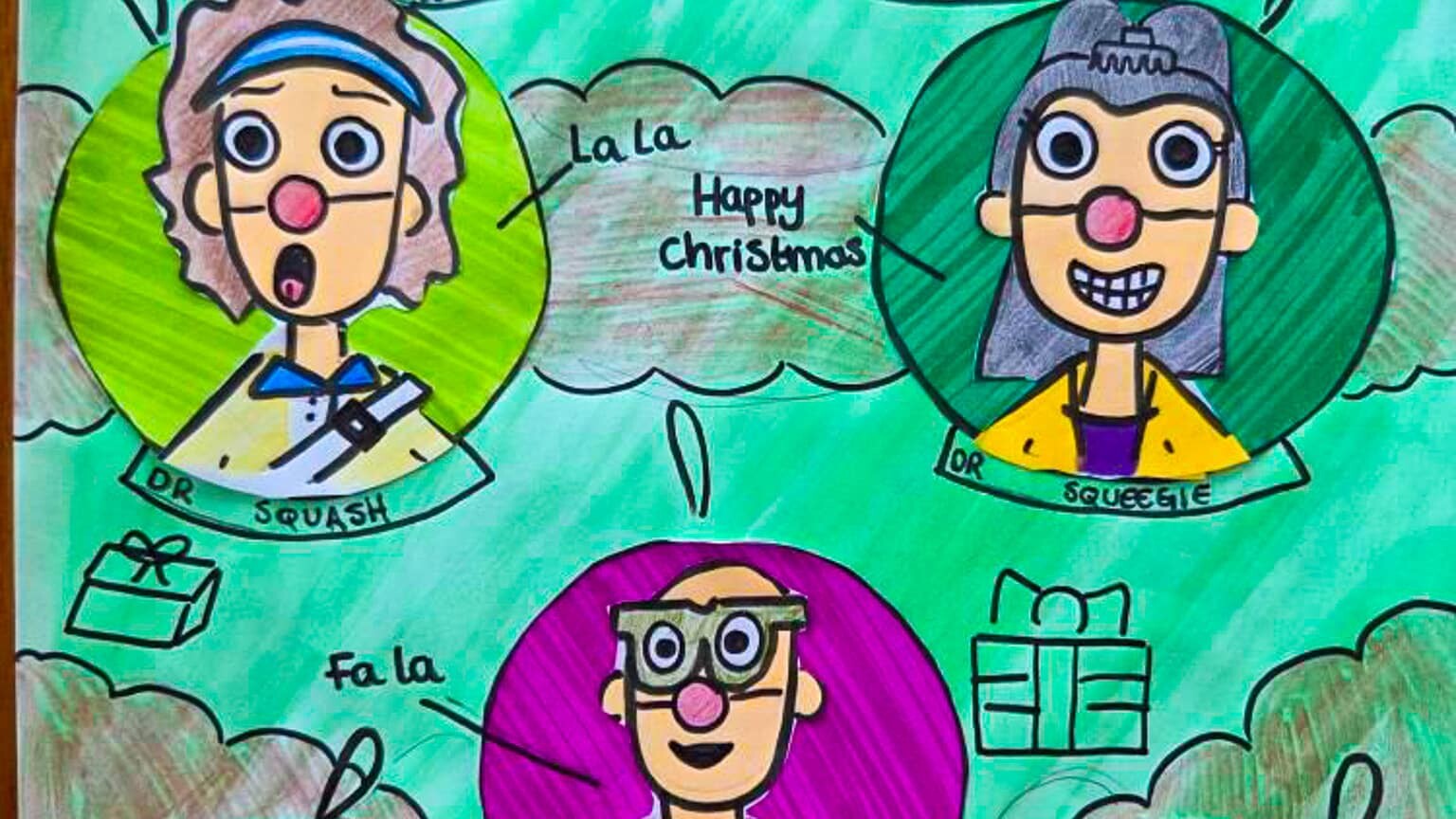
Elderflowers - Hearts and Minds. Improving lives, one smile at a time.

Just a small red nose

Our Elderflowers visit in pairs, wear vintage clothing and a red nose, and carry a bag full of objects like hats, maps, photographs and instruments. They are, what we call, character clowns. Character clowns are gentle, naïve, optimistic, honest and simple. They find hope in every situation and excitement in the smallest things. 

Listen to this Podcast!

Rachel Colles speaks about the Elderflowers in this UCL podcast with host Professor Rochelle Burgess and Dr Carrie Ryan about Ageing Playfully.

Phyllis Logan speaks about The Elderflowers

Our Elderflower Ambassador and Honorary Elderflower Phyllis Logan speaks about the the difference The Elderflowers can make to those living with dementia.


In a care home corridor Honey and a gentleman are looking at each other and smiling
In a care home lounge. Buddy Elderflower sit with a lady. They are looking at each other and laughing

Professional Performers who become healthcare clowns – AKA The Elderflowers.

Our Elderflowers are carefully selected professional performers. They are selected for their empathy, compassion, respect and playfulness as well as their clown abilities. 

They are trained in clowning techniques including improvisation, surprises, music, slapstick, celebrating mistakes and rhythm. They are also trained how to clown in healthcare environments for older people living with dementia and other associated cognitive difficulties, who might be feeling anxious, isolated, confused, or frustrated, have sensory decline, and a loss of confidence and self-esteem. 

Once our performers are finished all their training, they become a healthcare clown. What this means is that your unique visit from the Elderflowers can have a therapeutic effect. The Elderflowers demand nothing of these ladies and gentlemen except playing in the moment, meeting with whoever they are right there and then and use healthcare clowning and humour to stimulate cognitive functioning, decrease anxieties and increase communication, social interaction, resilience and self-esteem, giving agency and empowerment, and creating lots of happy, long-lasting, hormones from laughing. 

And no two visits are the same. 


In a care home. Sweetie-Pie and Dipsy Elderflower are visiting an adult with mid length white hair. Dipsy is holding their hand and they are all deep in conversation

This is how it works

When our Elderflowers arrive at a hospital, the staff will let us know which residents to see that day. We might see some ladies or gentlemen once or twice, but mostly we have ongoing visits, building up a relationship and friendship with many of the participants. We work closely with the staff, discussing and feeding back to them about our visits and progress with our participants. Each visit is as unique as the individuals we visit.

Our Elderflowers might use Scottish music (staff told them the gentlemen loves bagpipe music), or the Elderflowers might ask advice about which hat they should wear to a party (staff told them the ladies were feeling low), or the Elderflowers might use gentle slapstick to get muddled up in a sheet they are trying to fold, and a couple of ladies will come to help them (staff told them the ladies are bored), or the Elderflowers might need help with their maps, planning where to go on their holidays and requiring advice about which hills to climb (staff told them that the gentleman climbed Munros). 

Each visit is ‘made to measure’ and improvised, and each visit is focussed on the participant and their needs, bringing humour, sensitivity and positivity to their space. 

Dipsy Elderflower is in a care home garden. She is in hold with a gentleman and dancing whilst Sweetie-Pie stands a little way off playing the harmonica

Where the Elderflowers visit?

Our Elderflowers currently visit the Borders General Hospital, Findlay House (in Edinburgh) and Clackmannanshire Community Healthcare Centre (Sauchie). We have been visiting Borders General Hospital for over 20 years.

We have previously been asked/invited to visit people living with dementia in units at Royal Edinburgh Hospital, Murray Royal Hospital (Perth) and Queen Margaret Hospital (Dunfermline). We have also visited various residential care homes through our work with Kinections and Rights Made Real.

Portrait of a smiling female clown wearing glasses, a red nose, a red velvet bolero jacket, a light blue skirt, red heels, and a flower in her hair.
Portrait of a female clown wearing a white chef's hat, a red nose, a blue polka dot dress, and a blue cardigan, leaning forward with a curious expression.
Two female clowns standing side by side laughing together. Both wear yellow jackets and red noses; the one on the left wears a red beret and teal pants, while the one on the right wears a pink tutu skirt and has a pink flower in her hair.
Portrait of a female clown with blonde hair, wearing a red nose, a green cardigan, a green and yellow floral skirt, green heels, and a yellow flower in her hair, holding a bouquet of yellow and brown flowers.
Full-length photo of a female clown posing with a red bow in her grey-streaked hair, wearing a floral dress, pink gloves, a pearl necklace, Converse sneakers, a red nose, and carrying a picnic basket.

Help us to enrich people’s lives and improve well-being.Healthcare clowns are not just for LAUGHS!

There are lots of ways you can support Hearts&Minds. We are a Scottish charity that works in collaboration with paediatric healthcare units, respite centres, additional support needs (ASN) schools, and Dementia units. Our healthcare clowns offer authentic emotional connection accessible to all, whatever their circumstance.

Help us make a difference.

Sign Up to our Newsletter & Follow Us

It’s a great way to support us!  Keep up to date with all that’s going on with Hearts & Minds and learn more about our amazing work.


    A group of ten men wearing white charity t-shirts, red noses, and colourful grass skirts posing outside in front of green trees.

    Fundraise

    Choose whatever challenge or fundraiser you would like to do – just make it something fun that you’ll enjoy!

    Fundraise for Hearts & Minds
    In a classroom. Dr Beatz is kneeling opposite a young person with her hands on their shoulders. Their faces are close together and they are smiling

    Adopt a Clowndoctor

    Our Clowndoctors really need your support. Adopt a Clowndoctor today and help them make a difference and for children in hospital, hospice care and SEN schools.

    Adopt a Clowndoctor
    In hospital. A child with a nasogastric tube is held by a woman and is about to grab a sponge red nose from a Clowndoctors thumb

    What Makes Us Different

    Hearts & Minds help vulnerable people overcome feelings of powerlessness, anxiety and isolation through the art of therapeutic clowning.

    What we do

    Thanks to the organisations who support our work

    Two Clowndoctors posing dynamically. The bearded male clown on the left wears blue pants and a yellow coat, lifting his leg while the female clown on the right, wearing glasses and a yellow coat, holds his leg up. Both wear red noses.

    © 2026 Hearts & Minds. All Rights Reserved.

    Hearts & Minds Limited | Registered Company in Scotland No.SC178916 | Registered Office: Lower Ground, 4 Castle Terrace, Edinburgh, EH1 2DP | Scottish Charity No. SC027040

    Sign up to our Newsletter

    for all things Hearts & Minds


    This will close in 0 seconds

    Share your story


    This will close in 0 seconds